Friday, April 23, 2010

YouTube and Usability, Again

As a follow-up to an earlier post I read the following in Google User Groups:

YouTube's "product team" is not about functionality.

In fact, their prime directive seems to be to remove as much function as possible, while making every remaining operation as non-intuitive, cumbersome, and fugly as possible.

Their complete destruction of the video watch page is the latest prime example.

Couldn't have said it better myself. Google has an amazing product line (YouTube) but every action it seems to take baffles me.

End Users in Action

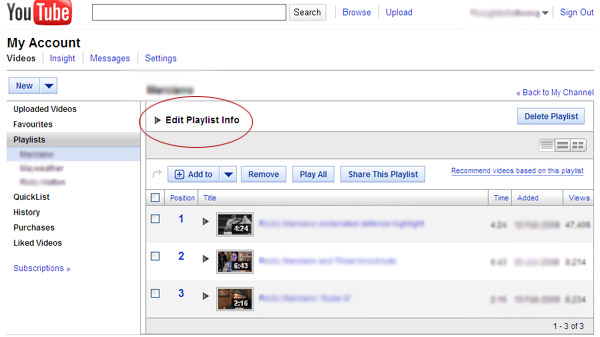
I was working with a client setting up a YouTube channel and had an interesting learning experience. The client wanted to change the name of one of his newly created playlists and was unable to do so.


He tried clicking on the list on the left, then right clicked on the name in that list[1]; clicked on the name of playlist [2]; then searched the buttons above the videos -- with the mouse moving back and forth [red box], left and right over the buttons; then clicked the drop-down arrow next to the ADD TO [3]; went to change screen icons on the right [4]; went back up to his Channel Name and chose the dropdown from there. [5] Came back this screen and gave up.


A co-worker spent at least 15 minutes looking around the Google YouTube help pages without able to find it. Both the client and the co-worker are experienced "expert" computer users. Both missed where they were supposed to go. Both assumed -- because of YouTubes low functionality -- that they would have to delete their playlist and create a new one.

Both couldn't believe it when I showed them the link.

How illuminating it is to watch users in action.

So, how does one edit the name of the playlist?


If you're on your "My Channel" screen (not on this screen) you have to:

1. Select the drop down by your channel name
2. Select Favorites
3. On the left column select "Playlists"

You are then at "this" screen.

4. Select the drop down by "Edit Playlist Info"
5. Edit the title (should be clear at this point)

Thursday, April 22, 2010

Digital Photocopies and Identity Theft

Just in case you haven't seen this article:

Digital Photocopiers Loaded With Secrets
Your Office Copy Machine Might Digitally Store Thousands of Documents That Get Passed on at Resale

Nearly every digital copier built since 2002 contains a hard drive - like the one on your personal computer - storing an image of every document copied, scanned, or emailed by the machine.

Tuesday, April 20, 2010

Daniel Kahneman: On Remembered Happiness


Daniel Kahneman had a fascinating presentation at the TED 2010 conference on experiential vs remembered happiness. One of the illogical quirks of humans, according to Kahneman, is that we make future decisions based on how happy we remember an experience and not on how happy we actually were while experiencing the actual event. This is an interesting and useful conclusion for everyone in business who wants return customers.

Kahneman presents an interesting example contrasting the "experiencing" self versus the "remembering" self with patients who underwent colonoscopies. I would recommend seeing the presentation, but cutting the example to its core: people whose entire experience was painful and short would have a better "rememberance" if the experience was a little longer and the pain and discomfort at the end was bearable. This would hold true even if the technician doing the colonoscopy would "continue" with the proceedure simply for show for a few momements.

How does this apply to customer experience, to your role as a business person or IA? Pay attention to your customers remembered happiness as well as the experiential.

Speakers from TED 2010

Monday, April 19, 2010

Linking: How clearly differentiated do they need to be?

Have we finally passed the Jakob Nielsen threshold when it comes to linking? We now see sites, such as CNN, designed for the most basic of users presenting numerous different navigation models.


For example today’s edition of CNN uses several different models, few of them explicit. The top navigation assumes users know that they are links. The graphics link to the story, as do the titles below them. It is assumed that the user knows to click on them. Underneath the titles is a description of the article followed by the words FULL STORY. Although FULL STORY has a slightly different color the link differentiation is remarkably subdued. Below the lead articles are a list of articles under the label "Latest News." As with FULL STORY the visual differentiation is limited to a slight color variation.

My only quibble with the usability aspects of this page is that the description text should also link to the article.

Nonetheless we are crossing a major threshold here. Average users are expected to assume that links exist without any visual clues. Will there still be users who go to this site and be confused as what to do next? Yes but people who are confused will soon be crossing into Crocodile Dundee territory. After all EVERYONE knows what escalators and elevators do.

Saturday, April 17, 2010

Print Friendly URLs

Pages with a "print friendly" version usually deliver the same content but with a slightly different URL such as &print=yes. The print friendly version should be blocked from being indexed as users should not arrive at a "print friendly" page directly from the SERP. The most important reason is that the page does not provide the same navigational clues and outlets as do normal pages; secondly the print-friendly pages formatting does not lend itself to be the first glimpse users have of your site.

Monday, April 12, 2010

Yelp - Trying to Fix a Problem that won't go away

Jeremy Stoppelma, the CEO of Yelp, wrote in Yelp's official blog that:

"User trust is the foundation on which Yelp is built and the reason 31 million consumers turned to the site last month to find a great local business. Today we're announcing two important product changes to reinforce that trust and make it even more clear that Yelp treats review content equally for all businesses, with no connection between advertising and reviews.

Specifically, we're adding the ability to see reviews filtered by our review filter and we're discontinuing the "Favorite Review" feature that's part of our advertising package."

Jeremy - what you need to do is to make certain that the reviews are from real people and are not placed there by companies; and to combat bad, spiteful reviews allow discussions on the comments (comments on the comments). This is not taking into account the "pay-for-play" perception where becoming a paid advertiser on Yelp enables you to remove bad comments and put up good ones.

Yelp is a good idea but falls short in execution.